Key Insights
- Creators help users understand complex products and build confidence to act.
- Brands focus on measurable outcomes like CAC, conversions, and retention.
- The right content, platforms, and niche creators lead to better results.
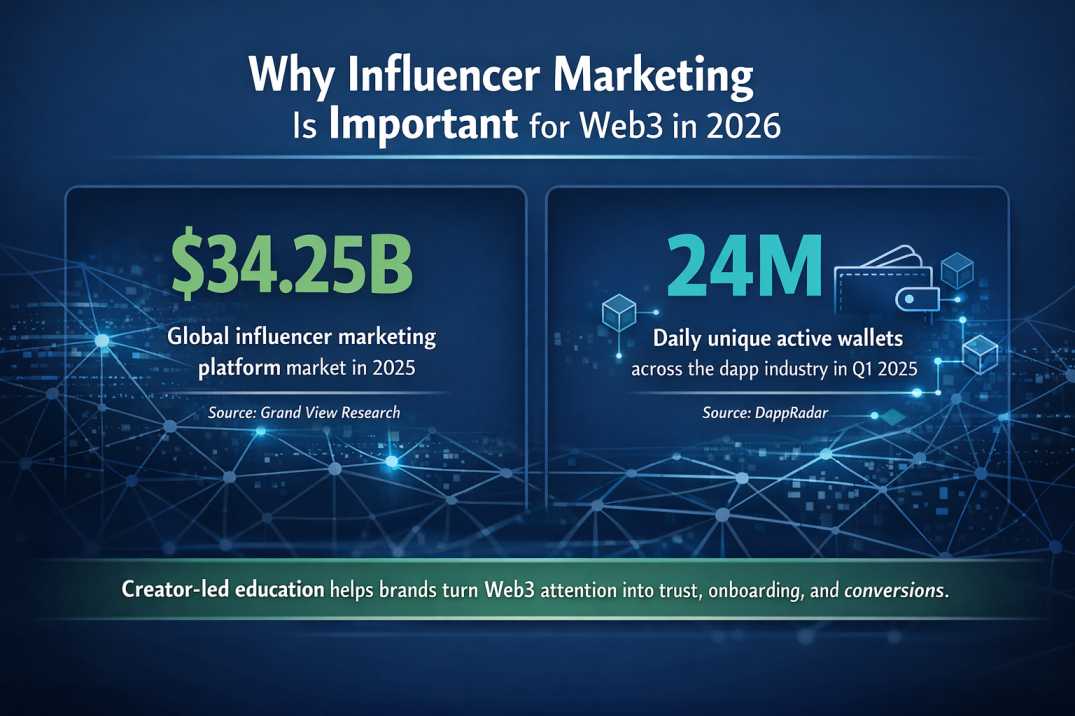
Influencer marketing has become a stronger growth channel in 2026, especially for industries that depend on trust and education. The global influencer marketing platform market reached $25.44 billion in 2024 and is expected to hit $34.25 billion in 2025, which shows how fast brands are shifting budget toward creator-led campaigns. That shift matters even more for Web3 companies, where products often need explanation before users feel ready to act.
Web3 audiences are harder to win with generic ads. Many users have grown cautious after years of hype, failed projects, and unclear product claims. They want credible voices who can explain how a wallet works, why a protocol matters, or what risks a user should understand before joining. That demand is backed by real user activity. DappRadar reports that the dapp industry recorded 24 million daily unique active wallets in Q1 2025, which shows that Web3 attention is large, active, and worth competing for. That is why creator-led education has become such an effective way to capture Web3 attention and move users from curiosity to action.
What Is Influencer Marketing in the Web3 Context?
In Web3, influencer marketing means using creators, educators, analysts, and community figures to explain and promote blockchain-based products. These products can include exchanges, wallets, DeFi protocols, blockchain games, NFT projects, and infrastructure platforms. The creators involved are often more technical than mainstream lifestyle influencers, and their audiences usually follow them for product analysis, market commentary, and practical tutorials.
This makes Web3 influencer marketing more educational than many traditional creator campaigns. A sponsored post alone rarely works in crypto or blockchain because the audience expects substance. Brands often rely on YouTube videos, X threads, livestreams, Discord AMAs, and hands-on walkthroughs that show real usage and answer common concerns. That content helps reduce friction and makes the product easier to understand.
How Web3 influencer marketing differs from traditional influencer campaigns
Traditional influencer campaigns often focus on style, aspiration, or fast product discovery. Web3 campaigns work differently because the products are more technical and the user journey is more demanding. A user may need to set up a wallet, understand fees, learn token utility, or assess security risks before taking the next step. That means creators need to act as teachers, not just promoters.
Audience quality matters more than broad reach in this setting. A smaller creator with a trusted niche audience can produce better results than a large creator with weak relevance. Current creator marketing research also shows continued interest in smaller, more engaged creators, especially as brands put more pressure on measurable return and conversion quality.
Why influencer trust matters more in Web3 than in mainstream digital channels
Trust has extra weight in Web3 because mistakes carry a real cost. Users can lose money, misunderstand token mechanics, connect to the wrong contract, or follow poor advice. That history has made many crypto users skeptical of polished brand messaging. They often trust creators more than ads, but only if those creators show product knowledge, honesty, and a clear record of good judgment.
Disclosure matters here too. The U.S. Federal Trade Commission requires influencers to clearly disclose material relationships with brands, and that standard is especially important in categories tied to financial claims and consumer risk. In Web3, clear disclosure is not only a legal issue. It is a credibility issue, and credibility is often the factor that decides whether a user listens or leaves.
Why Influencer Marketing Matters for Captivating Web3 Users in 2026
The attention problem in Web3 markets
Web3 markets are crowded with token launches, protocol updates, partnership posts, and community campaigns that all compete for the same audience. Many of these messages look and sound alike, so users filter them out quickly. That weakens broad paid campaigns and gives an advantage to creators who already have audience trust and a clear point of view.
A strong influencer can break through that noise by framing a product in useful terms. They can compare it with rivals, explain where it fits, answer doubts in public, and create repeat exposure through multiple pieces of content. This matters most for products with a learning curve, such as DeFi apps, blockchain games, and multi-chain wallets, where trust and clarity shape conversion.
2026 creator marketing trends shaping Web3 acquisition
The biggest 2026 trend is accountability. Creator programs are now judged more like performance channels, with brands tracking ROI, CAC, attributed sales, and creator-specific revenue. Current trend reporting also points to longer partnerships, hybrid payment models, stronger affiliate systems, and better attribution tools that connect creator activity to real business outcomes.
This shift fits Web3 well. Many crypto and blockchain firms face tighter budget review than they did during earlier bull-market periods, so they need proof that creator spend leads to funded wallets, active users, or retained players. Better tracking and stronger creator selection help brands treat influencer marketing as a repeatable acquisition channel instead of a one-off awareness experiment.
Where Web3 user attention is actually growing
Web3 attention is not evenly distributed. Gaming remains one of the clearest entry points, with DappRadar reporting that blockchain gaming continued to account for a large share of dapp activity in late 2025. That makes gaming creators valuable partners because they can show gameplay, explain digital ownership, and make onboarding feel less intimidating for new users.
DeFi, stablecoins, and practical payment use cases also keep drawing attention. Chainalysis has highlighted global crypto adoption patterns and the role of stablecoins in usage across many markets. In these areas, creators help move the conversation away from hype and toward utility, which is exactly what many businesses need when they want to attract serious Web3 users in 2026.
Want to captivate Web3 users and drive real growth in 2026?
Reach Web3 users with trusted creators and drive measurable growth.

Who Should Invest in Web3 Influencer Marketing?
Best-fit businesses and organizations
Web3 influencer marketing works best for companies that sell products users need to understand before they trust. That group includes crypto exchanges, wallets, DeFi apps, blockchain game studios, NFT loyalty programs, and layer-1 or layer-2 ecosystems. It fits infrastructure firms too, especially those that need developer trust or strong market education. In each case, the sale starts with belief. A user needs to believe the product is real, useful, and safe enough to try. Creator-led content helps build that belief in public, and it does so in formats users already follow each day. Web3 firms need that support more than most sectors. Chainalysis says India and the United States led its 2025 global crypto adoption index, which shows just how large and diverse the addressable market has become.
The best fit is not limited to retail crypto brands. B2B blockchain companies can gain value too. A custody provider, analytics platform, security firm, or payments company often faces a trust gap that standard ads cannot close. A respected creator, founder, analyst, or technical educator can explain the product in plain terms and give it social proof with the right audience. That matters in markets where buyers spend time on X, YouTube, newsletters, podcasts, Telegram, and Discord before they book a demo or install a wallet. Creator programs have become more structured and more tied to revenue in 2026, which makes them easier to justify for both consumer and enterprise teams.
Commercial signals that your business is ready
A business is ready for Web3 influencer marketing once it has a clear product, a defined audience, and a way to measure user action after content goes live. Readiness shows up in simple signs. The team knows which user group it wants most. The product already has a working funnel. The company can track sign-ups, wallet connects, funded accounts, game installs, or trial requests. It has legal review for claims and disclosures. It has enough budget to test several creators at once. These signs matter more than company size. A small wallet app with a tight onboarding flow is often more ready than a large protocol with weak attribution.
Budget pressure is another strong signal. Creator marketing now faces the same scrutiny as paid search, affiliate, and paid social. Impact.com says brands in 2026 are focusing on CAC, AOV, ROI, long-term creator ties, and hybrid pay models instead of vanity metrics. That shift favors firms that need efficient growth and can act on performance data. A company that still judges campaigns by impressions alone is not ready. A company that can compare creator spend with funded wallets or retained users is ready.
How Web3 Influencer Marketing Works: A Practical Framework
Step 1 – Define the commercial objective
The first step is simple. Pick one business goal. Do not ask one creator program to drive awareness, education, conversion, community growth, and retention at the same time. A wallet launch may need funded accounts. A blockchain game may need installs and active players. A DeFi app may need qualified deposits from users who understand the product. A B2B infrastructure firm may need demo requests from technical buyers. One clear target creates better briefs, better creator selection, and cleaner reporting.
This step matters more in Web3 than in many other sectors. Many products carry friction at the point of action. A user may need to install software, verify identity, move funds, or learn risk. That means campaign design must match the exact business result the team wants next. Impact.com and CreatorIQ both describe a 2026 market where creator work is judged by commercial impact, not broad awareness alone. A clear objective keeps the campaign tied to that standard from day one.
Step 2 – Segment the target Web3 audience
Web3 is not one audience. New users want clear tutorials and safety tips. Active traders want product depth and fee details. Gamers want proof that the game is fun before they care about token mechanics. Developers want technical credibility. Treasury or payments buyers want practical use, lower friction, and compliance comfort. A team that treats all of them the same will waste spend and lose trust.
Good segmentation starts with user intent. Ask what the audience wants right now, then match the message to that need. Stablecoin users often care about transfers, liquidity, and practical use. Chainalysis and TRM Labs both point to strong growth in retail-led adoption and stablecoin activity in 2025. Those users need very different content from NFT collectors or DeFi yield seekers. The stronger the segment, the better the creator fit and the cleaner the result.
Step 3 – Select creator tiers by business goal
Creator size should follow the goal, not ego. Micro creators often work best for Web3 campaigns built around trust, education, and niche conversion. Their communities are smaller, but the audience often knows why it follows them. That creates stronger discussion and better intent. Macro creators can still help, especially for broad launches or major partnerships, yet they rarely carry a full campaign on their own.
Recent research supports this shift. Impact.com says 2026 winners are moving toward smaller creators and long-term partnerships. Its micro-influencer guidance says brands that combine affiliate and influencer programs generate 46 percent higher affiliate-based sales than affiliate activity alone. Separate reporting cited by DataSlayer says 73 percent of brands prefer micro and mid-tier creators for stronger engagement-to-cost ratios. Those numbers fit Web3 well, where niche trust often beats broad reach.
Step 4- Match content format to funnel stage
Top-of-funnel content should create clarity fast. Short videos, creator commentary, and simple explainers work well at this stage. Mid-funnel content should answer objections and teach the product. This is where tutorials, comparison videos, livestream demos, and community Q and A sessions do their best work. Bottom-funnel content should remove friction at the point of action. Referral links, creator landing pages, promo codes, and guided onboarding sessions can push users from interest to action.
Many brands miss this step and publish the same content type at every stage. That wastes both money and attention. A user who has never heard of a protocol does not need a referral code first. The user needs context. A user who already watched three explainer videos does not need another broad intro. The user needs a clear path to sign up, fund an account, or join a community. Matching content to stage is what turns creator work into a measurable growth channel.
Step 5 – Track performance with business KPIs
The right KPI depends on the business goal set at the start. For retail products, common measures include cost per funded wallet, cost per first trade, cost per install, deposit volume, and day-30 retention. For games, teams often watch install-to-active-user rates, quest completion, and repeat play. For B2B products, they track demo requests, qualified meetings, trial starts, and influenced pipeline. These metrics tell a real story. Reach alone does not.
Tracking needs structure. Use creator-specific links, landing pages, referral codes, affiliate tools, and post-click analytics. Tie those data points to retention and revenue where possible. The 2026 creator market rewards that discipline. Impact.com describes creator marketing as a core commercial engine, and that label only fits programs that can prove business value.
Choosing the Right Influencers for a Web3 Campaign
What makes a creator valuable in Web3
A valuable Web3 creator has three traits. The first is audience trust. The second is topic fit. The third is teaching skill. Reach still matters, yet it comes after those three. The best creators can explain hard products in plain language, ask tough questions in public, and keep their credibility after the sponsorship ends. That type of creator can lower fear and raise conversion at the same time.
Real value shows up in behavior, not just audience size. Look for creators who stay active in one niche, respond to comments, and publish content that holds attention over time. Many 2026 trend reports point to a more professional creator class with better workflows, stronger reporting, and deeper brand ties. Web3 brands should look for that maturity, not just follower counts.
Red flags to avoid
The biggest red flags are easy to spot. Watch for inflated engagement, thin product knowledge, and constant promotion of new tokens with little follow-up. Watch for creators who make risky financial claims or hide paid relationships. The FTC says material connections must be disclosed clearly, and advertisers stay responsible for truthful endorsements. That rule matters in every sector, and it carries extra weight in crypto, where poor claims can damage users and brands fast.
Vetting checklist for brands and agencies
A strong vetting process starts with audience match. Then review content quality, platform mix, prior partnerships, engagement patterns, and comment quality. Check whether the creator can explain the product without reading brand copy line by line. Check whether the audience asks real questions and gets real replies. Then review compliance history and disclosure habits.
The final check is commercial fit. Can this creator move the exact user your business needs next? That question keeps the campaign honest. In 2026, the strongest Web3 creator programs are not built on hype. They are built on trust, fit, and proof.
Best Content Formats for Influencer Marketing in Web3
Educational content that reduces onboarding friction
Educational content does the hardest job in Web3. It turns a confusing product into a usable one. A wallet guide, a staking walkthrough, or a clear explanation of gas fees can remove the fear that stops a first action. This format works well for exchanges, wallets, DeFi apps, and blockchain games that need users to understand setup steps before they convert. Current creator marketing research shows that brands now treat creator work as a commercial channel tied to measurable outcomes, so education is no longer a soft branding asset. It is part of the conversion path.
The best educational formats are product demos, live sessions, short explainers, and creator-led series. A series matters more than a single post. Sprout Social points to growing interest in episodic social content in 2026, and that pattern fits Web3 well. A single tutorial can introduce a product. A short series can cover setup, risk, common mistakes, and next steps. That gives users repeated exposure and enough detail to act with confidence.
Community-first content that drives belonging
Community-first content works on a different level. It does not just explain a product. It makes users feel part of a group. That matters in Web3, where many products depend on active communities, repeat participation, and public identity. Discord town halls, X Spaces, Telegram chats, AMAs, creator quests, and challenge-based campaigns can create social proof that paid ads rarely match. This style of content works best for blockchain games, NFT communities, token ecosystems, and early-stage consumer apps.
Belonging has real business value. A user who joins a live session and asks questions is more invested than a user who only watched a branded video. The creator becomes a bridge between the brand and the audience, and that bridge can keep attention alive after launch week ends. Impact.com notes that 2026 creator programs are shifting toward long-term partnerships and niche communities where trust runs deep. Community-first content fits that model. It builds repeated contact, stronger recall, and better retention.
Performance-oriented content that converts
Performance-oriented content is built for action. It asks the user to do one clear thing, such as sign up, install a wallet, fund an account, join a waitlist, or use a referral code. This content works best at the lower end of the funnel, once users already know the product. It often takes the form of creator-specific landing pages, promo codes, affiliate links, time-bound offers, and short product use cases with a direct call to act. In 2026, brands are putting more weight on this format as creator programs face the same budget discipline as paid media.
This format works only if the content still feels credible. A Web3 audience can spot a forced sales push fast. The strongest conversion content shows real usage, clear benefits, and honest limits. That is why smaller creators often perform well in this stage. Their audiences are tighter, and the trust level is higher. Impact.com reports that brands combining affiliate and influencer work see 46 percent higher affiliate-based sales than those using affiliate programs alone. That figure helps explain why more Web3 teams now treat creators as part of the revenue engine, not just the awareness mix.
Thought-leadership content for enterprise and infrastructure brands
Thought-leadership content matters most for enterprise buyers, developers, and technical decision-makers. A custody provider, analytics platform, security firm, or infrastructure network rarely wins through short hype clips. It wins through depth, credibility, and repeated proof. This content often appears as founder interviews, technical briefings, analyst conversations, webinars, podcasts, long-form video explainers, and creator roundtables. The goal is to shape trust in a category where buyers study risk, reliability, and fit before they speak with sales.
This content works best when the creator has real authority. A respected researcher or builder can ask sharper questions than a general business influencer, and that changes how the audience judges the brand. Enterprise Web3 marketing often moves slowly, so a single strong interview can feed many channels over time. Brands can turn one expert video into clips for X, newsletter quotes, paid retargeting creative, and webinar follow-ups. Impact.com says creator content now fuels paid, retail, email, and other channels in 2026, which makes this format more useful than its top-line reach may suggest.
Platform Strategy: Where to Reach Web3 Users in 2026
X, YouTube, Telegram, Discord, TikTok, podcasts, and niche communities
Each platform plays a different role in the Web3 funnel. X is strong for news, commentary, fast reactions, and community pulse. YouTube is strong for product education, reviews, and deeper trust building. Telegram and Discord support live community interaction and ongoing support. TikTok helps with top-of-funnel awareness for consumer-facing apps and games. Podcasts work well for founder credibility and deeper category discussion. Sprout Social reports that YouTube stands out for business impact among marketing leaders, which aligns with its value for long-form crypto education.
Web3 brands should not chase every channel at once. They should pick the channels that match user behavior and content depth. A DeFi product that needs explanation will gain more from YouTube and X than from a TikTok-only plan. A blockchain game may need YouTube creators, Discord communities, and short-form clips together. Niche communities still matter most of all. A well-placed creator in a trusted subcommunity can drive more qualified action than a broad campaign with weak fit.
Best channels by use case
Use case should decide platform choice. Wallets, DeFi apps, and infrastructure products need channels that allow explanation and trust to build over time. That usually means YouTube, X, podcasts, newsletters, and smaller expert communities. Blockchain games need channels where product experience can be shown, so YouTube, Discord, livestreams, and short video all matter. Consumer crypto products aimed at newer users can benefit from TikTok and Shorts, but only if the content stays clear and concrete.
Gaming gives a clear example. DappRadar reported 5.8 million daily unique active wallets in blockchain gaming in Q1 2025, and gaming held a leading share of dapp activity later that year. Those users do not just need ads. They need proof that the game is fun and that onboarding is manageable. A gameplay creator on YouTube or Discord can provide that proof in a way static creative cannot. DeFi and enterprise buyers follow a different path, so brand teams need different channel mixes for each audience.
Multi-channel distribution and paid amplification
The strongest Web3 campaigns do not leave creator content on one platform. They reuse it across the funnel. A long YouTube review can become short clips for X and TikTok, quote cards for Telegram, and retargeting creative for paid social. This matters more in 2026 as brands push for more output from each creator deal. Impact.com says creator content now powers paid, email, retail, and other channels, which reflects a broader move toward integrated media planning.
Paid amplification works best after the brand identifies high-performing creator assets. That order matters. The creator proves which message and format connect with real users, then paid media extends the reach. This reduces guesswork and can improve return on spend. For Web3 teams with lean budgets, that is a practical way to stretch content value without flooding audiences with generic brand creative.
Start Your Web3 Influencer Marketing Campaign Today
Influencer Marketing vs Traditional Paid Media for Web3 Growth
Trust, education, and community fit
Traditional paid media can buy reach fast, but Web3 products often need more than reach. They need trust and explanation. A display ad can announce a wallet or protocol. It cannot answer a skeptical user’s questions in real time or show how the product works in practice. A trusted creator can do both. That is why influencer marketing often performs better in categories where the user needs to learn before acting.
Community fit is another dividing line. Paid ads speak from the brand outward. Creator content speaks from inside a community the audience already follows. That difference matters in Web3, where belonging and reputation shape buying behavior. A good creator can translate brand language into community language without losing accuracy. Paid media alone rarely achieves that.
Speed to market vs depth of engagement
Paid media wins on speed. A team can launch ads in hours, test audiences fast, and control spend with precision. That makes paid search and paid social useful for quick demand capture, retargeting, and launch support. Creator marketing moves slower. The brand has to source creators, brief them, review content, and wait for audience response. Yet that slower process often produces deeper engagement and better message retention.
Depth matters in Web3. A user who watches a creator’s demo, joins a live Q and A, and then clicks a referral link has more context than a user who only saw a banner. That usually leads to stronger conversion quality. So the choice is not speed or depth forever. It is knowing which stage of growth needs which tool at that moment.
Attribution challenges and advantages
Paid media still has cleaner attribution in many cases. Platforms provide dashboards, audience data, and direct performance signals. Creator marketing has made major progress, though. Brands now use affiliate tools, creator codes, custom landing pages, post-click analytics, and revenue sharing to tie creator activity to real business outcomes. Impact.com points to this shift as one reason creator marketing is now measured with more commercial discipline.
Web3 adds both challenges and advantages here. It is hard to track every influence path across platforms and communities. Yet Web3 brands can often connect creator activity to wallet actions, funded accounts, quest completions, or on-chain behavior with more precision than many consumer categories can. That gives smart teams a better shot at proving creator value than they had a few years ago.
When to combine creator marketing with paid search, paid social, PR, and community ops
The strongest growth programs combine channels. Creator marketing should build trust, explain the product, and generate content users want to watch. Paid search should capture demand that already exists. Paid social should retarget viewers and extend proven creator assets. PR should support category credibility and major announcements. Community teams should keep users engaged after the click through Discord, Telegram, email, and product touchpoints.
This blended model fits Web3 better than a single-channel plan. Creator content starts the conversation. Paid media extends it. PR validates it. Community ops keeps it alive. Brands that connect these pieces can move users from awareness to action with far less friction than brands that rely on ads alone. That is why influencer marketing is not replacing paid media in Web3. It is making paid media work harder.
Sample 90-Day Web3 Influencer Marketing Plan
A 90-day plan works well for Web3 influencer marketing since it gives a brand enough time to test creators, validate messages, and connect content to business results. It is long enough for repeated exposure, which matters in a market where users rarely convert after one touch. Current creator marketing research shows that brands in 2026 are treating influencer programs as performance channels tied to CAC, ROI, and revenue. That change makes structured planning more important than ever. Web3 teams need a campaign plan that links creator output to funded wallets, active users, installs, deposits, or qualified pipeline, not just reach.
Days 1–30 – Strategy, audience mapping, creator sourcing
The first 30 days should focus on clarity. Start with one commercial goal, then define the audience in simple terms. A wallet brand may want first deposits. A blockchain game may want installs and active players. A DeFi app may want deposits from users who already understand yield and risk. Audience mapping should follow real use cases, not broad labels like “crypto users.” Chainalysis reported in September 2025 that India and the United States led its global crypto adoption index, and TRM Labs found strong adoption in South Asia and the United States in 2025. That means Web3 brands now reach user groups with very different levels of product knowledge, risk tolerance, and buying intent.
Creator sourcing should follow that audience work. Look for creators with trust inside the exact niche you want, not just high follower counts. Review their past content, comment quality, disclosure habits, and ability to explain a product in plain language. This is the stage where a brand builds its shortlist, rate cards, briefing notes, and review process. It is smart to include a mix of creator tiers. Micro creators often drive stronger trust in Web3, and 2026 trend reporting from impact.com points to micro-creators, hybrid pay models, and long-term partnerships as core themes. By the end of day 30, the team should know which creators it wants, what each one will produce, and which KPI each piece of content should support.
Days 31–60 – Content launch, testing, paid amplification
The next 30 days are about launch and controlled testing. Publish creator content in waves, not all at once. That gives the team room to compare hooks, formats, and audience response. Educational formats usually work first in Web3. A creator tutorial, product walkthrough, or live Q and A can reduce friction faster than a polished promo clip. DappRadar reported 24 million daily unique active wallets across the dapp industry in Q1 2025, with blockchain gaming alone reaching 5.8 million daily unique active wallets. Those numbers show large addressable audiences, but they do not remove the need for explanation. Users still need context before they act.
Testing should stay focused on a few variables. Change the creator, the message, or the content type, then track the result. Use creator-specific links, landing pages, referral codes, and post-click analytics from the start. Paid amplification should come after the team identifies top-performing creator assets. This order matters. First, the creator proves which message connects with the audience. Then the brand expands that winning asset with paid spend. Impact.com says creator content now powers paid, email, and other channels in 2026, which makes this middle phase a strong point for cross-channel gains.
Days 61–90 – Optimization, attribution, retention, scale
The last 30 days should answer one question: which creator inputs produced real business value? This is where the team compares cost per funded wallet, cost per install, conversion rate, deposit volume, day-30 retention, or qualified meetings. Broad reach is less useful here. The goal is proof. A creator with lower reach and stronger retention may deserve more budget than a larger creator with weak conversion quality. Impact.com describes 2026 creator marketing as a commercial engine measured by accountability and real ROI, so the final phase has to connect spend with outcomes.
Retention needs attention in this phase too. Web3 brands often spend heavily to win the first action, then lose users after the first week. Creator content can help reduce that drop. Follow-up tutorials, community check-ins, creator-led onboarding, and post-launch explainers can keep users active after sign-up. This is where a long-term creator partnership beats a one-off post. Brands should end day 90 with a clear scale plan: which creators to renew, which formats to repeat, which channels deserve more spend, and which weak spots need fixing before the next cycle.
Conclusion
Influencer marketing for Web3 is no longer a side tactic in 2026. It is a serious growth channel for brands that need trust, education, and measurable user action. A strong 90-day plan helps companies turn Web3 influencer marketing, crypto influencer marketing, and blockchain influencer marketing into repeatable acquisition efforts that support funded wallets, active users, stronger retention, and long-term brand credibility.
For businesses that want expert support, Blockchain App Factory offers focused crypto influencer marketing services built for Web3 growth. Brands that invest in the right influencer marketing for Web3 strategy, backed by trusted creators and clear performance tracking, will be in a far stronger position to capture attention and convert high-intent users in 2026.

Vimal J is the Head of Sales at Blockchain App Factory, with 10+ years of experience in sales, client strategy, and Web3 business growth. He helps startups, enterprises, and project founders choose the right blockchain solutions for their goals, bringing a practical market perspective to topics like token development, crypto launches, and Web3 adoption.