


Key Insights
- Solidity, Vyper, Rust, and Move affect security, cost, launch speed, and maintenance. The right fit depends on the target chain and product model.
- Solidity and Vyper suit EVM chains, Rust fits Solana and CosmWasm, and Move powers Aptos and Sui. Businesses should choose the chain first, then pick the language.
- Strong audits, skilled developers, and mature tools reduce post-launch risk. A language with poor team fit can raise costs after deployment.
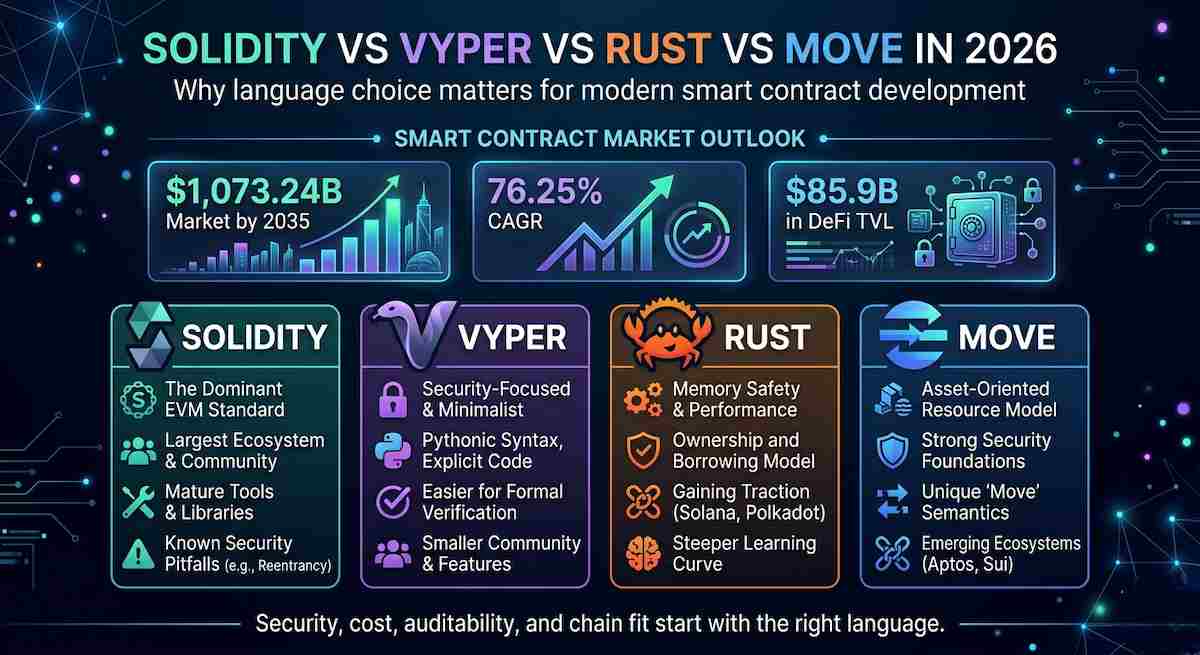
Smart contract language choice now affects far more than code style. It shapes product security, audit cost, launch speed, network fit, and long-term upkeep. As adoption accelerates, the business stakes are rising quickly. The global smart contracts market is projected to grow from USD 3.69 billion in 2025 to USD 1,073.24 billion by 2035, at a 76.25% CAGR between 2026 and 2035. At the same time, DeFi protocols currently secure about USD 85.9 billion in total value locked (TVL), showing how much capital already depends on secure and reliable smart contract logic. A DeFi protocol, NFT marketplace, DAO platform, token launch, or Web3 game all depend on contract logic that controls assets, user permissions, payments, staking, governance, and upgrades.
In 2026, four languages lead most business discussions: Solidity, Vyper, Rust, and Move. Solidity and Vyper serve Ethereum and other EVM networks. Rust plays a major role in Solana programs and also supports CosmWasm development across chains built on the Cosmos stack. Move powers asset-focused ecosystems such as Aptos and Sui, where security, ownership, and on-chain asset management are central design priorities. A weak language fit can slow delivery, raise audit bills, and create security gaps. For businesses, the right choice comes down to one question: which language best supports the product, chain, team, and risk profile? The answer affects the full build cycle, from architecture and development to audit, deployment, and post-launch upgrades.
What Are Smart Contract Languages?
Definition of Smart Contract Programming Languages
Smart contract languages help developers write self-executing blockchain logic. This logic runs on-chain and follows preset rules.
A smart contract can mint tokens, move assets, check ownership, manage votes, release rewards, or settle trades. Once deployed, the contract executes based on user actions and blockchain state.
Teams use smart contract programming languages to build:
- DeFi lending, staking, swaps, and yield platforms
- NFT collections and marketplaces
- DAO voting and treasury systems
- Token launch contracts
- Web3 gaming assets
- Cross-chain bridges
- Blockchain infrastructure tools
- Real-world asset tokenization platforms
Solidity, Vyper, Rust, and Move all serve this goal. They differ in syntax, safety rules, developer base, execution model, and chain support.
Why Businesses Need the Right Smart Contract Language
The right smart contract language reduces risk and speeds up delivery.
A language with mature tools helps teams test faster. A language with clear rules helps auditors review code with less friction. A language with strong network support helps the product connect with wallets, exchanges, bridges, and dApps.
Language choice affects hiring too. Solidity developers are easier to find for EVM work. Rust developers fit Solana and CosmWasm projects. Move developers suit Aptos and Sui builds.
The wrong choice can create hidden costs. Teams can face longer training time, fewer audit firms, weaker library support, and harder upgrades. These issues often appear late, once budgets and launch dates are already fixed.
Key Evaluation Criteria for Enterprises
Enterprises should compare smart contract languages through practical business factors.
Blockchain ecosystem compatibility
The language must match the target chain. Solidity and Vyper fit EVM chains. Rust fits Solana and CosmWasm. Move fits Aptos, Sui, and other Move-based networks.
Security model
Security starts with language design. Vyper favors simplicity and auditability. Move uses resources to protect digital assets. Rust gives low-level control with strong memory safety. Solidity gives broad power, but teams need strict standards and careful audits.
Developer talent availability
A larger talent pool reduces hiring time. Solidity has the broadest Web3 developer base. Rust has strong demand in Solana and infrastructure projects. Move talent is growing with Aptos and Sui adoption.
Auditability
Clean syntax, limited features, and strong test tools help auditors find issues faster. Vyper and Move appeal to teams that place audit clarity first. Solidity has deep audit coverage, but complex code can raise review time.
Gas cost and execution performance
Gas cost affects users directly. Contract language, compiler behavior, data layout, and network design all shape execution cost. Rust gives teams strong control over program structure on Solana. Solidity and Vyper costs depend on EVM bytecode patterns.
Tooling and framework maturity
Tooling affects daily build speed. Solidity has mature frameworks, libraries, security tools, and test suites. Rust has strong tooling for Solana and CosmWasm. Move tooling is improving across Aptos and Sui.
Upgradeability and maintenance
Businesses need contracts that can adapt safely. The language should support clean modules, readable code, and safe upgrade paths. Poor maintenance planning can turn a successful launch into a costly rebuild.
Integration with wallets, exchanges, bridges, and dApps
A smart contract rarely works alone. It must connect with wallets, token standards, exchanges, bridges, oracles, analytics tools, and front-end apps. EVM languages gain from wide integration support. Rust and Move projects need ecosystem-specific planning.
Overview of the Top Smart Contract Languages in 2026
Solidity: The Dominant EVM Smart Contract Language
Solidity is the leading language for Ethereum smart contracts and EVM smart contract development. The Solidity docs describe it as an object-oriented, high-level language for smart contracts. The language targets the Ethereum Virtual Machine and takes influence from C++, Python, and JavaScript.
Solidity remains the default choice for many DeFi, NFT, DAO, token, and enterprise Web3 builds. It works across Ethereum, Polygon, BNB Chain, Arbitrum, Optimism, Avalanche C-Chain, Base, and many other EVM networks.
For businesses, Solidity offers three clear strengths. The developer pool is large. Tooling is mature. Integration support is broad.
A Solidity smart contract development company can build with known frameworks such as Hardhat, Foundry, and OpenZeppelin. This helps teams move from prototype to audit to deployment with fewer unknowns.
Solidity suits projects that need:
- Ethereum smart contracts
- EVM smart contract development
- DeFi and token platforms
- NFT marketplaces
- DAO governance systems
- Enterprise blockchain apps on EVM chains
The tradeoff is complexity. Solidity gives developers many patterns and features. That power needs strong coding rules, tests, and expert audits.
Vyper: A Security-Focused Pythonic Language for EVM
Vyper is a contract-oriented, Pythonic language that targets the EVM. Its docs stress safety, clear coding, and lean execution.
Vyper smart contract development appeals to teams that want readable and audit-friendly contracts. The syntax feels familiar to Python developers, but the language removes some features that can make contracts harder to review.
This makes Vyper a strong fit for simpler DeFi modules, treasury contracts, staking logic, and contracts that need clear behavior over broad flexibility.
Vyper suits projects that need:
- Secure smart contract language support
- EVM audit-friendly contracts
- Clean financial logic
- Smaller contract surfaces
- Better review clarity for audit teams
Vyper has a smaller developer pool than Solidity. It also has fewer libraries and examples. For many EVM projects, Solidity still offers faster hiring and broader tooling. Vyper works best where contract clarity and audit speed matter more than ecosystem size.
Rust: High-Performance Smart Contract Development
Rust is a strong choice for high-performance blockchain development. Solana’s docs state that Solana programs are mainly developed in Rust.
Rust smart contract development gives teams strong control over program logic, memory behavior, and data structures. Solana programs written in Rust have minimal structural requirements, and each program needs an entrypoint that starts execution.
Rust is common in Solana smart contract development and CosmWasm smart contracts. It suits products that need speed, custom logic, and close control over execution.
Rust suits projects that need:
- Solana smart contract development
- CosmWasm smart contracts
- High-throughput DeFi apps
- On-chain games
- Custom blockchain modules
- Performance-heavy Web3 infrastructure
The tradeoff is build complexity. Rust can require more setup, more boilerplate, and deeper engineering skill than higher-level languages. Frameworks such as Anchor help Solana teams write faster, but native Rust still demands strong technical discipline.
Move: Resource-Oriented Smart Contract Language for Digital Assets
Move is built around digital assets. Aptos describes Move as a safe and secure Web3 language that focuses on scarcity and access control. Assets can be stored in resources, and structs cannot be copied or dropped by accident.
Sui uses Move through packages, modules, and objects. Its docs describe Move as a language for safe packages that manage on-chain objects.
Move smart contract development fits products where assets sit at the center of the system. That includes tokenized assets, NFT logic, gaming objects, DeFi positions, loyalty points, and financial products on Aptos or Sui.
Move suits projects that need:
- Aptos smart contracts
- Sui Move development
- Asset-oriented blockchain development
- Strong ownership rules
- Object-based on-chain logic
- Secure transfer and access control
Move has a smaller talent base than Solidity and Rust. The ecosystem is younger too. Yet its design gives businesses a strong foundation for asset-heavy Web3 apps.
For Aptos and Sui projects, Move is not just a language choice. It shapes how the product models ownership, access, and asset flow from the start.
Solidity vs Vyper vs Rust vs Move: Quick Comparison Table
Business-Level Comparison
| Criteria | Solidity | Vyper | Rust | Move |
|---|---|---|---|---|
| Best for | EVM dApps, DeFi, NFTs, DAOs | Security-focused EVM contracts | Solana, CosmWasm, high-performance apps | Asset-centric apps on Aptos/Sui |
| Learning curve | Moderate | Easier for Python developers | Steeper | Moderate to advanced |
| Ecosystem maturity | Very high | Smaller but focused | Strong in Solana/Cosmos | Growing rapidly |
| Auditability | Strong, but complexity varies | High due to simplicity | Requires specialized review | Strong resource-based safety model |
| Enterprise fit | Excellent for EVM projects | Good for high-security EVM use cases | Excellent for performance-heavy use cases | Strong for digital asset ownership models |
Solidity in 2026: Strengths, Limitations, and Business Use Cases
Why Solidity Remains Popular
Solidity remains the leading language for EVM smart contract development in 2026 because it offers wide network support, mature tools, strong documentation, and a large developer community. Businesses choose Solidity because it helps them build and launch faster across Ethereum, Polygon, BNB Chain, Avalanche C-Chain, Arbitrum, Optimism, Base, and other EVM-compatible networks.
Solidity also benefits from strong ecosystem support. Wallets, exchanges, bridges, analytics tools, and DeFi platforms already support many Solidity-based contracts, making it a practical choice for tokens, DEXs, lending platforms, NFT marketplaces, and DAO systems.
Key Technical Features of Solidity
Solidity provides a broad feature set for building complex smart contracts, including:
Object-oriented contract structure
Solidity lets teams organize logic into contracts, interfaces, and libraries for cleaner development.
Contract inheritance
Developers can reuse base contracts across token, staking, governance, and access control modules.
Interfaces and libraries
Interfaces allow contracts to communicate, while libraries help reuse tested logic for math, security, and token functions.
Events and modifiers
Events help track on-chain activity, while modifiers apply access checks, pause rules, and validation logic.
Mature testing frameworks
Tools like Hardhat, Foundry, and Remix support testing, debugging, deployment, and verification.
Support for common Web3 standards
Solidity supports popular standards for tokens, NFTs, DeFi, DAOs, and governance systems, with libraries such as OpenZeppelin offering reusable implementations.
Commercial Use Cases for Solidity
Solidity is widely used for EVM-based Web3 products, including:
- DeFi lending platforms
- DEX development
- NFT marketplaces
- Token development
- DAO governance systems
- Real-world asset tokenization
- Enterprise blockchain automation
When Businesses Should Choose Solidity
Businesses should choose Solidity for EVM-compatible applications that need broad wallet, exchange, bridge, and DeFi ecosystem support. It is ideal for launching tokens, building DeFi platforms, creating NFT marketplaces, developing DAO tools, and connecting with existing EVM infrastructure.
A Solidity smart contract development company can help businesses move faster by using proven libraries, tested contract patterns, and mature deployment tools.
Solidity Limitations to Consider
Solidity is powerful, but complex contracts can increase security risks. Inheritance, external calls, upgrade proxies, and permission logic require careful design. Production-grade Solidity development also needs skilled developers, strong testing, gas optimization, manual audits, and security reviews.
Although Solidity developers are easier to find than many Web3 specialists, experienced senior talent remains competitive and costly. For most EVM projects in 2026, Solidity remains the safest business choice when combined with clean architecture, strict testing, and expert audits.
Vyper in 2026: Secure and Auditable Smart Contract Development
Why Vyper Appeals to Security-First Projects
Vyper appeals to security-first teams because it focuses on clear, simple, and auditable smart contract code. Its design favors readability over developer convenience, making it easier for auditors and business teams to understand contract behavior. This is especially useful for contracts that manage large funds or sensitive financial logic.
Key Technical Features of Vyper
Pythonic syntax
Vyper uses a Python-like style, making basic code easier to read for developers familiar with Python.
EVM compatibility
Vyper runs on the Ethereum Virtual Machine, so it can be used for Ethereum and other EVM-compatible networks.
Compiler-enforced simplicity
The compiler restricts complex patterns, helping developers avoid risky or unclear code structures.
Reduced feature complexity
Vyper removes or limits advanced features that may hide logic, supporting more direct contract design.
Strong readability for auditors
Vyper’s clean structure helps auditors review state changes, permissions, value transfers, and external calls more efficiently.
Commercial Use Cases for Vyper
Vyper is best suited for focused, high-value smart contract logic where audit clarity matters. Common use cases include:
- DeFi protocols
- Stablecoin contracts
- Treasury management contracts
- Governance modules
- High-value financial logic
- Audit-first protocol components
When Businesses Should Choose Vyper
Businesses should choose Vyper for clear, security-focused EVM contracts with narrow and important business logic. It is a strong fit for financial contracts, treasury controls, stablecoin systems, governance rules, and protocol modules that need easier audits and lower code complexity.
Vyper Limitations to Consider
Vyper has a smaller developer ecosystem than Solidity, fewer reusable libraries, and less enterprise adoption for broad dApp development. Although it looks like Python, production Vyper development still requires deep EVM knowledge, including gas optimization, storage design, access control, and smart contract security.
Need secure smart contracts for your Web3 project?
Build reliable Solidity, Vyper, Rust, or Move contracts with expert development, testing, and audit-ready code.

Rust in 2026: Performance-Oriented Smart Contract Development
Why Rust Is Important for Blockchain Development
Rust is important in blockchain development because it offers speed, safety, and low-level control. It is widely used in performance-focused ecosystems such as Solana and CosmWasm, making it suitable for high-volume apps like trading platforms, games, NFT engines, and Web3 infrastructure tools.
Key Technical Features of Rust for Smart Contracts
Memory safety
Rust helps manage memory safely without a garbage collector, supporting predictable blockchain program behavior.
Performance control
Rust allows developers to optimize data structures and execution paths for high-volume applications.
Strong type system
Rust catches many errors at compile time, reducing the risk of bugs before deployment.
Low-level control
Rust gives engineers detailed control over program behavior, which is valuable for complex smart contracts.
Fit for high-throughput blockchain apps
Rust is well suited for DeFi trading, gaming, minting, and settlement systems that require fast transaction processing.
Solana native programs and Anchor
Solana programs are commonly written in Rust, either natively or with Anchor, which simplifies development, testing, deployment, and security checks.
CosmWasm contracts for Cosmos
Rust is widely used for CosmWasm smart contracts, supporting DeFi, DAO, bridge, and app-chain products in the Cosmos ecosystem.
Commercial Use Cases for Rust Smart Contracts
Rust is ideal for systems that need speed, custom logic, and strong engineering control, including:
- High-frequency DeFi platforms
- On-chain trading infrastructure
- GameFi platforms
- NFT minting engines
- Real-time settlement systems
- Cosmos-based applications
- Enterprise-grade Web3 infrastructure
When Businesses Should Choose Rust
Businesses should choose Rust for Solana, Cosmos, and performance-heavy Web3 products. It is a strong fit for exchanges, gaming platforms, NFT engines, trading systems, infrastructure tools, and high-volume DeFi applications that need fast execution and precise control.
Rust Limitations to Consider
Rust is powerful, but it has a higher learning curve than many smart contract languages. Teams may need more onboarding time, specialized debugging tools, and auditors who understand chain-specific environments such as Solana accounts or CosmWasm execution rules. Rust projects also require architecture designed around each blockchain’s runtime, storage model, and upgrade patterns.
Move in 2026: Asset-Centric Smart Contract Development
Why Move Is Gaining Attention
Move is gaining attention because it treats digital assets as first-class items. It was designed for safe asset control, scarcity, and secure transfers, making it useful for tokens, NFTs, game assets, financial assets, and ownership records.
Key Technical Features of Move
Resource-oriented programming
Move uses resources to represent assets, preventing accidental copying or deletion.
Asset scarcity by design
Move requires explicit abilities for actions like copy and drop, helping protect scarce assets.
Strong access control
Move lets developers define strict rules for creating, storing, transferring, and modifying assets.
Formal verification support
Move supports formal verification, helping teams prove important rules in high-value contracts.
Object-centric development on Sui
Sui Move focuses on objects, making it suitable for NFTs, gaming assets, rewards, and ticketing.
MoveVM execution model
Move runs on a dedicated virtual machine used by chains like Aptos to execute smart contract transactions.
Safer digital asset handling
Move reduces common asset-handling risks by enforcing safer ownership and transfer logic.
Commercial Use Cases for Move
Move is suitable for products where asset ownership is central, including:
- Digital asset platforms
- Gaming assets
- Supply chain ownership tracking
- Tokenized real-world assets
- Loyalty and reward systems
- Financial applications on Aptos and Sui
- Secure NFT and object-based applications
When Businesses Should Choose Move
Businesses should choose Move when building asset-centric products on Aptos, Sui, or other Move-based ecosystems. It is a strong fit for tokenized assets, NFTs, game items, ownership tracking, financial apps, and projects that need strict transfer logic or formal verification.
Move Limitations to Consider
Move has clear advantages, but businesses should consider a few tradeoffs. The developer pool is smaller than Solidity’s, Aptos Move and Sui Move have different models, EVM integrations are more mature, and Solidity teams may need time to learn Move’s resource-based approach.
Want to launch faster with audit-ready smart contracts?
Smart Contract Language Selection Framework for Businesses
Step 1: Define the Business Model
Start with the product, not the language. A DeFi protocol needs different contract logic than an NFT marketplace or gaming platform.
A lending app needs collateral rules, liquidation checks, interest logic, and oracle links. A marketplace needs minting, listings, royalties, payments, and dispute rules. A DAO needs voting, treasury control, proposal checks, and timelocks.
The business model should guide the language choice.
Use this quick map:
- DeFi protocol: Solidity, Vyper, Rust, or Move based on target chain
- NFT marketplace: Solidity for EVM, Move for Sui or Aptos, Rust for Solana
- Gaming platform: Rust for Solana, Move for Sui, Solidity for EVM games
- RWA tokenization platform: Solidity for wide integrations, Move for asset-first logic
- DAO: Solidity for EVM governance, Vyper for narrow treasury modules
- Payment app: Solidity for EVM reach, Rust for Solana speed, Move for asset safety
- Launchpad: Solidity for EVM tokens, Rust for Solana launches
- Enterprise automation: Solidity for EVM partner support, Move for ownership-heavy flows
Step 2: Choose the Blockchain Ecosystem
The target chain narrows the language choice fast.
Ethereum and EVM chains
Choose Solidity or Vyper. Solidity works best for broad dApps, tokens, DeFi, NFTs, and enterprise apps. Vyper works best for clear, high-value contract modules.
Solana
Choose Rust. Solana’s official docs state that Solana programs are primarily developed in Rust.
Cosmos and CosmWasm
Choose Rust. CosmWasm supports smart contracts for Cosmos-based chains, and Rust remains the main language path for many teams.
Aptos and Sui
Choose Move. Aptos and Sui both position Move around safe asset handling and on-chain object or resource control.
Step 3: Evaluate Security and Audit Requirements
Security needs change by product type. Financial protocols, staking platforms, lending apps, custody tools, and treasury contracts need deeper review.
High-value contracts need:
- Threat modeling
- Unit tests and integration tests
- Static analysis
- Manual audit
- Formal checks for key rules
- Access control review
- Upgrade safety review
- Emergency pause plans
Solidity offers a mature audit market. Vyper supports clear EVM code review. Rust needs Solana or CosmWasm audit skill. Move supports resource-based asset control and formal verification paths.
The best language still needs safe architecture. Poor access rules can break any contract.
Step 4: Assess Developer Availability and Maintenance Cost
Hiring affects delivery speed and budget. Solidity has the widest Web3 talent pool. Rust has strong talent, but blockchain-specific Rust skill costs more. Vyper and Move developers are harder to source.
Businesses should review:
- Internal team skills
- Hiring budget
- Outsourcing partners
- Audit partner availability
- Documentation quality
- Framework maturity
- Long-term support needs
- Upgrade and bug-fix plans
A language with a smaller talent pool can still work well. The team needs the right partner and a clear maintenance plan.
Step 5: Match Language to Go-to-Market Strategy
Language choice affects launch speed and market access. It shapes wallet support, liquidity access, exchange listing, grants, and partner deals.
Solidity helps products reach EVM users faster. Vyper helps teams ship narrow, audit-friendly EVM modules. Rust supports Solana speed and Cosmos app-chain growth. Move supports asset-first products on Aptos and Sui.
A business that needs wide wallet and exchange support often starts with Solidity. A team building fast trading tools on Solana should choose Rust. A product built around scarce digital assets on Sui or Aptos should choose Move.
The best choice is the one that matches the chain, product, team, and launch plan. A smart language decision saves time, lowers risk, and gives the product a stronger base from day one.
Conclusion
Choosing between Solidity, Vyper, Rust, and Move in 2026 starts with your business goal, target chain, security needs, and launch plan. Solidity fits EVM products that need wide market support. Vyper fits clear and audit-friendly EVM contracts. Rust suits Solana, CosmWasm, gaming, trading, and high-speed Web3 systems. Move works well for Aptos, Sui, and asset-centric apps that need strong ownership rules. The right smart contract language can cut audit friction, reduce build risk, and support easier growth after launch. Blockchain App Factory provides Smart Contract Development services for startups, enterprises, and Web3 brands that need secure, scalable, and business-ready blockchain applications.

Vimal J is the Head of Sales at Blockchain App Factory, with 10+ years of experience in sales, client strategy, and Web3 business growth. He helps startups, enterprises, and project founders choose the right blockchain solutions for their goals, bringing a practical market perspective to topics like token development, crypto launches, and Web3 adoption.
Article Reviewed by:
Arun Kamala Santhanath
Marketing Head, Blockchain App Factory


