TGE vs ICO: The Complete Guide to Modern Token Launch Models (2025)
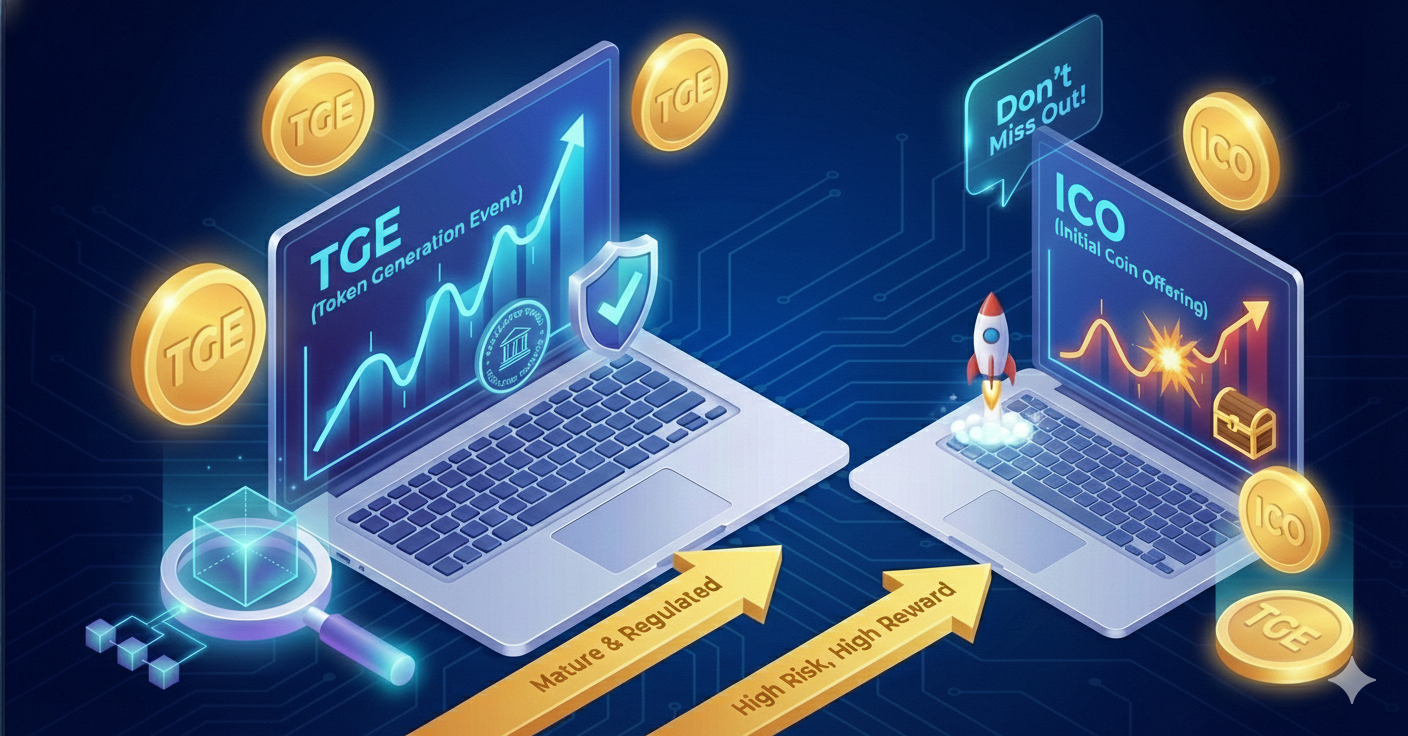
The crypto fundraising landscape has changed over time, moving from ICOs to more structured events like TGEs. Both models help projects launch tokens and attract investors, but they differ in how they operate, when they are used, and how they meet legal standards. Choosing the right one can shape a project’s growth, trust, and long-term reach.
This guide explains the difference between a Token Generation Event and an Initial Coin Offering. It walks through how each works, their benefits, the risks involved, and what makes them suitable for different stages of a project. By the end, you’ll have a clear view of which model supports your goals best.
Understanding Token Generation Events (TGE)
Transparent Token Creation and Distribution
A Token Generation Event represents the point when a blockchain project mints and releases its tokens for public use. Tokens are created on-chain and allocated to investors, team members, and ecosystem pools, ensuring open and verifiable distribution.
How a TGE Operates
During a TGE, tokens are generated through smart contracts and distributed automatically to participants. Claim portals allow users to access their tokens securely, while vesting schedules manage gradual releases to maintain value stability and discourage quick sell-offs.
Community Engagement and Ecosystem Growth
A TGE supports community participation by allowing token holders to engage in staking, governance, or payments. This process turns investors into contributors, helping the ecosystem expand while fostering trust and accountability within the project’s network.
Purpose of a TGE
The purpose of a TGE is to activate the token’s real utility within a functioning ecosystem rather than serve as a fundraising event. It promotes transparency, compliance, and long-term credibility, helping projects sustain value and build a loyal community.
Understanding Initial Coin Offering (ICO)?
Early-Stage Fundraising Through Token Sales
An Initial Coin Offering lets blockchain startups raise capital by selling tokens before launch. It allows early supporters to invest directly in the project while expanding reach across the global crypto community.
How an ICO Operates
Projects begin with a whitepaper that outlines goals, token supply, and roadmap. Investors buy tokens using crypto assets during presale or public rounds. Afterward, tokens are distributed and often listed on exchanges for trading.
Investor Participation and Growth
ICOs bring together individual and institutional investors at an early stage. This engagement builds active communities, increases awareness, and helps projects attract long-term supporters for development and ecosystem growth.
Purpose of an ICO
The goal of an ICO is to secure funding quickly while promoting innovation. It supports early adoption, liquidity, and visibility. Despite its benefits, participants must consider risks tied to speculation and minimal regulation.
TGE vs ICO: Core Differences Explained
Token Generation Events (TGEs) and Initial Coin Offerings (ICOs) share a common purpose of distributing tokens but differ greatly in approach and timing. ICOs were the early model that helped blockchain startups raise funds globally, fueling massive innovation. However, many faced legal issues due to unclear regulations and weak investor protection. TGEs later emerged as a safer, post-development alternative, emphasizing compliance, verified audits, and operational readiness before token release. As a result, investor sentiment has shifted toward TGEs for their transparency and accountability.
|
Aspect |
ICO |
TGE |
|
Objective |
Raise funds for project development |
Mint and distribute tokens for ecosystem use |
|
Timing |
Conducted before full product readiness |
Takes place after or during network readiness |
|
Regulation |
Often unregulated, especially before 2019 |
Typically compliant with KYC and AML standards |
|
Investor Risk |
Higher, since tokens are often promises of future value |
Lower, as tokens are already created and verifiable |
|
Transparency |
Depends on project disclosure |
Managed through auditable smart contracts and on-chain data |
|
Use Case |
Suited for early-stage ideas and startups |
Common for mature or compliance-oriented projects |
How TGEs and ICOs Work: From Concept to Launch
Understanding ICO Workflows
ICOs begin with a whitepaper that defines project goals and tokenomics. Investors send crypto like ETH or BTC during presale or public rounds. Once the campaign ends, tokens are issued or listed on exchanges for trade.
Understanding TGE Workflows
A TGE begins when the project reaches technical readiness. Tokens are minted through smart contracts, assigned to investor and team wallets, and released via claim portals with vesting to prevent market oversupply.
Technical Assurance
Audited smart contracts, blockchain explorers, and multisig systems keep both models transparent. Many projects host their launches on IDO or launchpad platforms to improve visibility, compliance, and community reach
Strengths of TGEs and ICOs in Project Development
Both Token Generation Events (TGEs) and Initial Coin Offerings (ICOs) offer distinct advantages suited to different project stages. TGEs emphasize transparency and compliance, while ICOs focus on accessibility and early growth.
Benefits of TGEs
- On-Chain Transparency: Every step of token creation and distribution is visible on the blockchain, ensuring public verification and accountability.
- Regulatory Alignment: TGEs operate within clearer compliance structures, following KYC and AML standards that enhance project legitimacy.
- Investor Confidence: Verified smart contracts and transparent audits build long-term trust and reduce perceived risk.
- Post-Development Readiness: TGEs are often launched after product or network completion, supporting sustainable funding and ecosystem growth.
Benefits of ICOs
- Quick Capital Access: Enables startups to raise funds efficiently without intermediaries or lengthy procedures.
- Global Reach: Opens participation to investors worldwide, helping projects attract early attention and credibility.
- Community Momentum: Creates early engagement and brand recognition that support token awareness before launch.
- Ideal for New Projects: Well-suited for early-stage startups with limited capital or resources to gain exposure and support.
Combined Strategy
- Many projects now merge both methods for stronger outcomes.
- A common model involves raising initial funds through an ICO, followed by a TGE for verified, compliant token issuance.
- Example: Avalanche’s 2020 hybrid presale and TGE approach achieved both liquidity and compliance while maintaining investor trust.
The Complete Process Behind Every TGE and ICO Launch
Launching a Token Generation Event (TGE) or an Initial Coin Offering (ICO) involves several strategic and technical stages. Each step ensures the token is planned, issued, and maintained responsibly while meeting regulatory standards and investor expectations.
Ideation and Tokenomics
The process starts with outlining the token’s purpose, supply, and distribution model. Each parameter defines how the token functions in the ecosystem. A balanced token design supports sustainable growth and long-term holder engagement.
Legal Structuring
Projects determine whether the token qualifies as a utility or security and select suitable jurisdictions. This stage involves preparing documentation and ensuring compliance with regulatory standards before making any public announcement.
Smart Contract Development
Developers create, test, and audit smart contracts to mint and deploy tokens securely. Independent audits confirm code reliability and transparency. These audits help prevent exploits while maintaining investor confidence in the project.
Community and Marketing
Teams promote awareness through campaigns, influencer partnerships, and online outreach. The goal is to inform potential investors, build credibility, and strengthen participation across community channels before the token sale or launch.
Event Execution
The main sale or token generation occurs during this phase. Investors participate through verified platforms, and KYC or AML checks are conducted to maintain transparency. Proper oversight ensures fairness and regulatory alignment.
Post-Launch Governance
After distribution, projects list their tokens on exchanges and manage staking or DAO activities. Governance mechanisms and analytics guide decision-making, helping maintain transparency, trust, and steady ecosystem participation.
Choosing the Right Model: TGE or ICO for Your Project
Choosing between a Token Generation Event (TGE) and an Initial Coin Offering (ICO) depends on a project’s maturity, funding goals, and compliance readiness. Each model serves a different purpose and attracts distinct investor groups. Founders should assess their development stage, market objectives, and regulatory position before deciding which path fits best.
Decision Factors:
- Regulatory Clarity: Projects under strict compliance rules should opt for a TGE, as it meets KYC and AML standards while maintaining transparent token activity.
- Early-Stage Capital Needs: Teams needing quick fundraising for early development may choose ICOs, providing faster access to capital and a broad investor reach.
- Investor Type: Retail investors favor ICOs for early access, while institutional participants prefer TGEs for transparency, verified audits, and trust.
- Development Stage: ICOs fit concept-phase projects seeking initial funding, while TGEs work best for live networks ready for token launch and distribution.
Framework Summary:
Many projects now combine both methods to balance funding speed and compliance. A team might raise early capital through an ICO, then conduct a TGE once the network or platform is ready for full token distribution.
Example:
NEAR Protocol followed this blended approach by securing funds through an ICO before its mainnet went live and later executing a TGE for token release after the ecosystem launch. This structure supported liquidity, compliance, and long-term project stability.
Real-World Case Studies of Successful TGEs and ICOs
Examining successful token launches shows how regulation, timing, and execution influence project outcomes. Over recent years, leading projects have proved that structured fundraising builds trust and lasting market credibility.
ICO: Ethereum (2014)
Ethereum’s ICO was one of crypto’s earliest large-scale funding events. It raised 18 million dollars by selling Ether to early backers, financing network growth that became the foundation for smart contracts and decentralized innovation.
TGE: Polkadot (2020)
Polkadot’s TGE followed a fully compliant and milestone-based process. Tokens were minted after the network launch, ensuring transparency, verified readiness, and regulatory alignment that improved investor trust and ecosystem integrity.
Hybrid Model: Avalanche (2020)
Avalanche used a hybrid model combining an ICO for early fundraising with a TGE for secure token issuance. The approach balanced liquidity and compliance, creating a trusted framework that appealed to both investors and developers.
Key Takeaway
Modern token launches succeed when they align timing, transparency, and trust. Projects that follow audited, compliant structures attract stronger communities and long-term investor confidence across evolving Web3 markets.
TGEs and ICO: Legal Foundations Every Startup Should Know
Step 1: Classify Your Token
Founders must identify whether their token is a utility or security using the SEC’s Howey Test. The classification determines how it can be launched, promoted, and traded in regulated markets.
Step 2: Understand Regional Laws
The United States enforces SEC and FinCEN oversight, while the EU’s MiCA 2025 standardizes crypto rules. Singapore and Dubai remain TGE-friendly hubs with clear and innovation-focused regulations.
Step 3: Secure Legal Foundations
Projects should run KYC and AML checks, conduct smart contract audits, and publish tokenomics. These steps prevent misuse, build credibility, and maintain trust with regulators and investors.
Step 4: Adopt Compliance Technology
On-chain audit trails and AI-based KYC systems automate verification, track transactions, and support transparent reporting. These tools ensure projects meet global compliance standards efficiently.
Step 5: Partner for Assurance
Modern TGEs collaborate with licensed compliance partners to oversee audits, KYC checks, and reporting. Such partnerships promote transparency, protect investors, and build lasting market trust.
Future Trends in TGEs and ICOs Driving Web3 Fundraising
The next wave of token fundraising is becoming more structured, regulated, and technology-driven. Modern TGEs and STOs focus on compliance, AI integration, and multi-chain growth, creating safer and more efficient ecosystems for startups and investors alike.
1. Regulated Fundraising Models
- ICOs are being replaced by compliant formats such as TGEs, STOs, and curated launchpads.
- These models emphasize legal structure, investor protection, and governance standards.
- Startups gain a secure and globally accepted framework for responsible fundraising.
2. AI-Based Verification Systems
- Artificial intelligence enhances investor verification and compliance processes.
- AI-driven KYC tools and fraud detection systems reduce manual errors and delays.
- Faster verification builds investor confidence and meets regulatory standards efficiently.
3. DeFi-Powered TGEs
- DeFi tools automate token issuance, liquidity control, and governance activities.
- Smart contracts ensure accuracy, fairness, and reliable transaction execution.
- DeFi-backed TGEs lower operational risk and promote long-term market engagement.
4. Cross-Chain Token Distribution
- Cross-chain TGEs connect blockchains such as Ethereum, Solana, and BNB Chain.
- Protocols like LayerZero, Wormhole, and Chainlink CCIP enable asset interoperability.
- This integration widens investor reach, strengthens liquidity, and unites ecosystems.
5. Compliance-Integrated Infrastructure
- Compliance tools are now built into token launches from the start.
- KYC/AML checks, smart-contract audits, and legal partnerships are standard.
- These measures reinforce regulatory alignment and safeguard project reputation.
6. Sustainability and Reputation Focus
- Projects prioritize ethical practices and long-term community accountability.
- Responsible fundraising builds credibility and strengthens market positioning.
- By 2026, TGEs are expected to dominate Web3 fundraising as trusted, compliant models.
Why You Need a Professional Token Launch Partner
Launching a TGE or ICO involves multiple layers of work that span technical development, compliance, and outreach. Every stage requires accuracy to meet regulations and market expectations. Partnering with professionals ensures that the project is built correctly and ready for investor participation.
Technical and Development Expertise
A token launch requires skilled engineers who understand blockchain networks, token standards, and smart contract logic. Professionals design, test, and deploy secure systems that perform efficiently while preventing coding or deployment errors.
Legal Structuring and Compliance
Compliance plays a vital role in token issuance. Expert teams prepare documentation, manage KYC and AML checks, and ensure that activities meet jurisdictional laws. This reduces legal exposure and strengthens credibility among investors.
Tokenomics and Exchange Support
Professionals help structure token supply, allocation, and release timelines that support market stability. They also coordinate listings on centralized and decentralized exchanges, improving accessibility and trading consistency.
Marketing and Community Building
A strong launch needs visibility and participation. Experienced agencies handle communication, branding, and investor relations to build awareness and community trust that continues beyond the launch phase.
End-to-End Coordination
Working with a launch company connects all moving parts under one plan. The result is a coordinated process that saves time, prevents missteps, and positions the project for growth and long-term success in the token economy.
Key Takeaways
Both TGEs and ICOs serve as vital tools in the token fundraising landscape, each addressing different project needs. ICOs are ideal for early-stage teams aiming to raise quick capital and build initial traction, while TGEs suit more developed projects seeking structured launches with stronger compliance and credibility. The choice ultimately depends on your project’s readiness, regulatory environment, and long-term community vision.
As the crypto space matures, the focus is shifting toward responsible execution and sustained value creation. Choosing the right fundraising model is not just about collecting funds but about setting a strong foundation for growth and trust. Partnering with experienced professionals ensures that your token launch meets both technical and legal expectations, giving your project the stability and confidence it needs to thrive in the evolving Web3 economy.

Blockchain App Factory
We are a leading Crypto Development Company offering complete blockchain and token creation services for global clients. With over 800 successful Web3 projects, we’ve helped ventures establish credible ecosystems that encourage real growth and user participation.
Our skilled team designs fair launch systems powered by audited smart contracts, liquidity models, and DAO governance, ensuring open access and steady community expansion from day one. We also deliver Web3 solutions covering DeFi platforms, NFT marketplaces, crypto exchanges, and metaverse ecosystems. Speak with our specialists today to launch your crypto project built for trust, performance, and long-term value.